AI lecture-video intelligence
Make every recorded lecture searchable, verifiable, and reusable.
SuperLearn indexes speech, slides, board handwriting, and textbook pages into one searchable space. Learners click concepts instead of scrubbing timelines. Every AI answer cites its sources — or declines to answer.
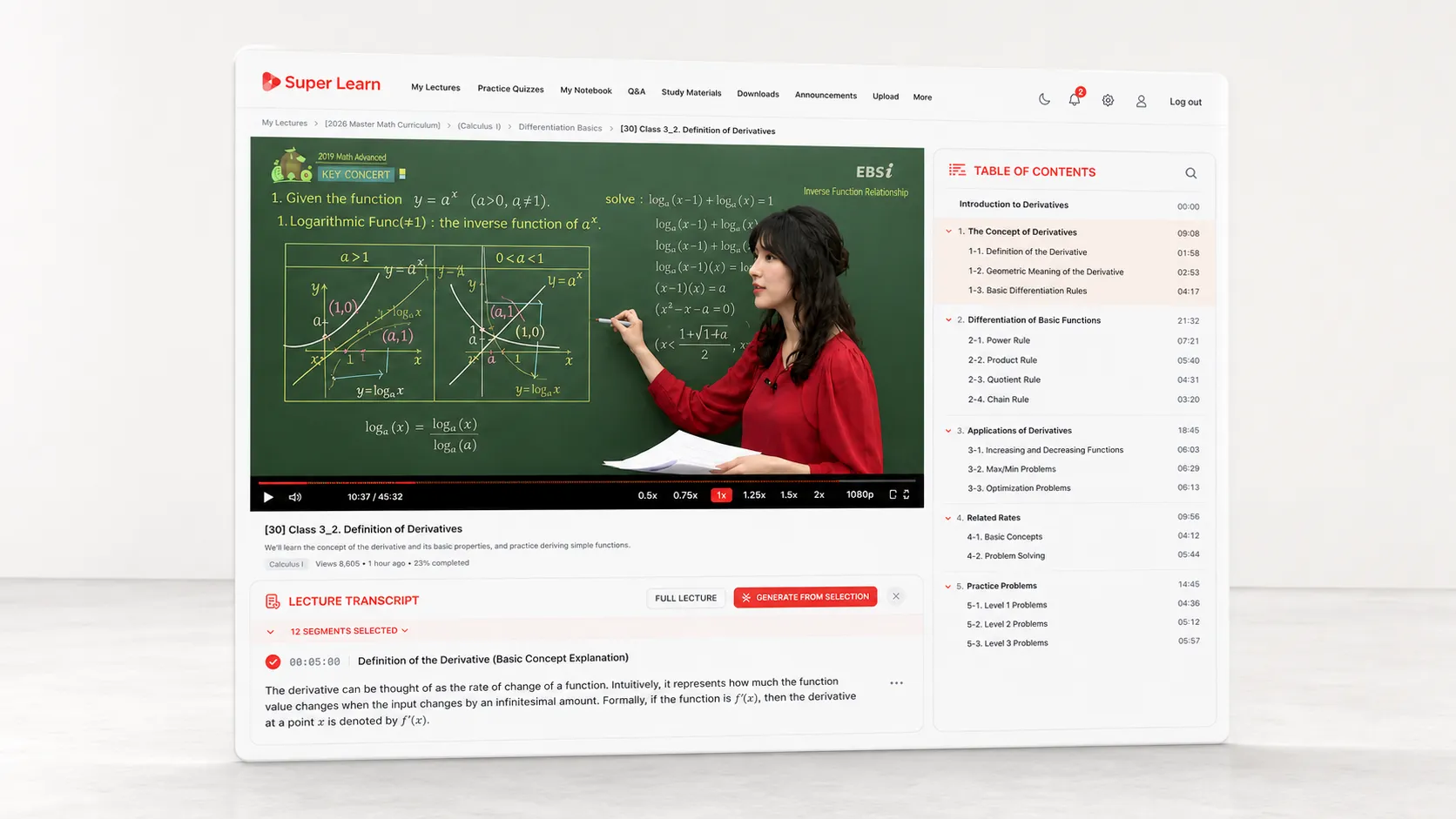
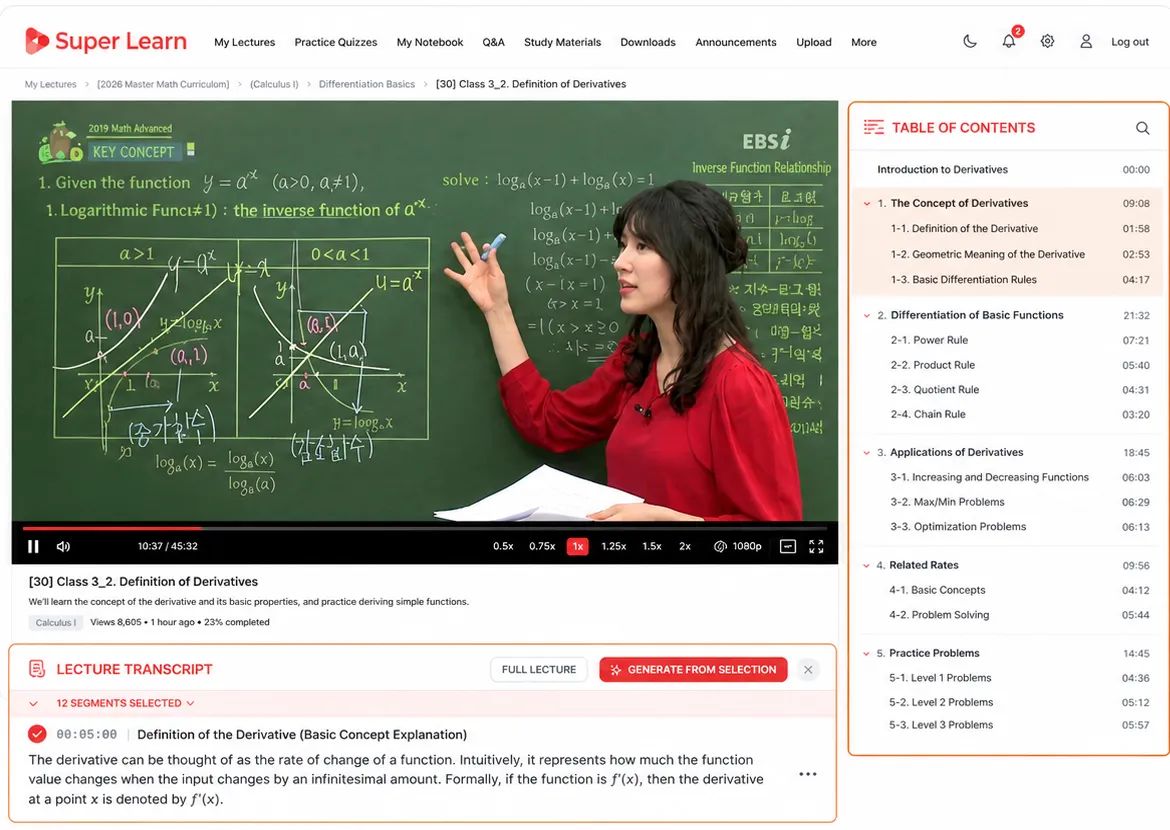
The SuperLearn player: video, auto-generated table of contents, and transcript in one view.
The problem
Institutions own thousands of lecture hours nobody can use.
Recorded lectures fail at four points — and each failure is structural, not a missing feature.
Navigation
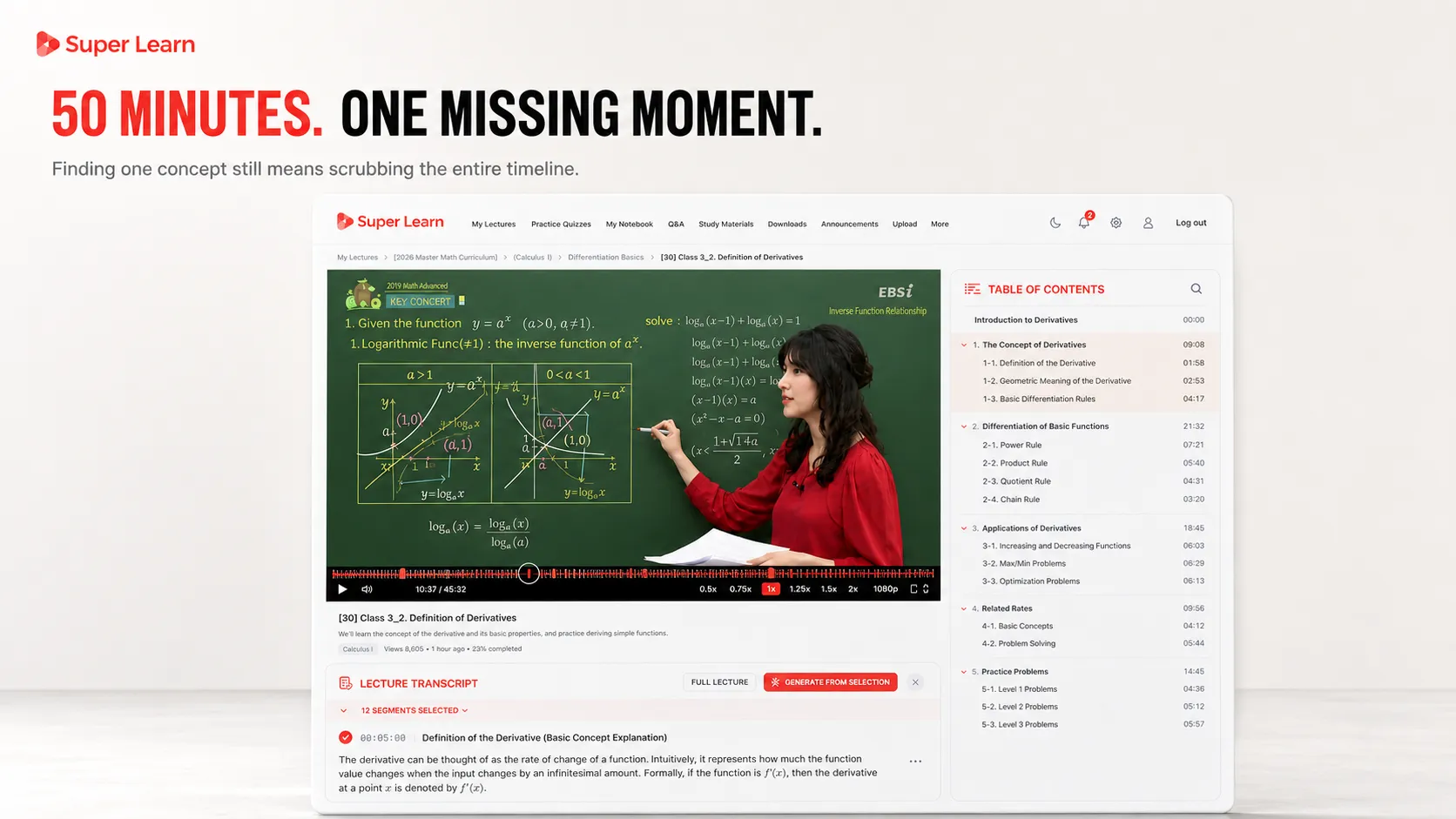
Finding one concept inside a 50-minute video means scrubbing a timeline. Many learners stop trying before they finish.
Trust
Generative AI tutors hallucinate. Learners re-verify every answer against the textbook, and the work of studying doubles.
Supply
Instructors spend over 60 minutes of manual post-production per 50-minute lecture, so content pipelines stall.
Cost
Frame-level vision AI is priced beyond public and vocational institutions, so archives stay unindexed.
The shared consequence: an archive that exists, and sits unused.
How it works
Four modalities. One index.
Upload a lecture. Five to fifteen minutes later, it is a structured, searchable asset.
01
Ingest
Automated processing indexes each video in 5 to 15 minutes after upload. No manual tagging, no re-encoding workflow.
02
Align
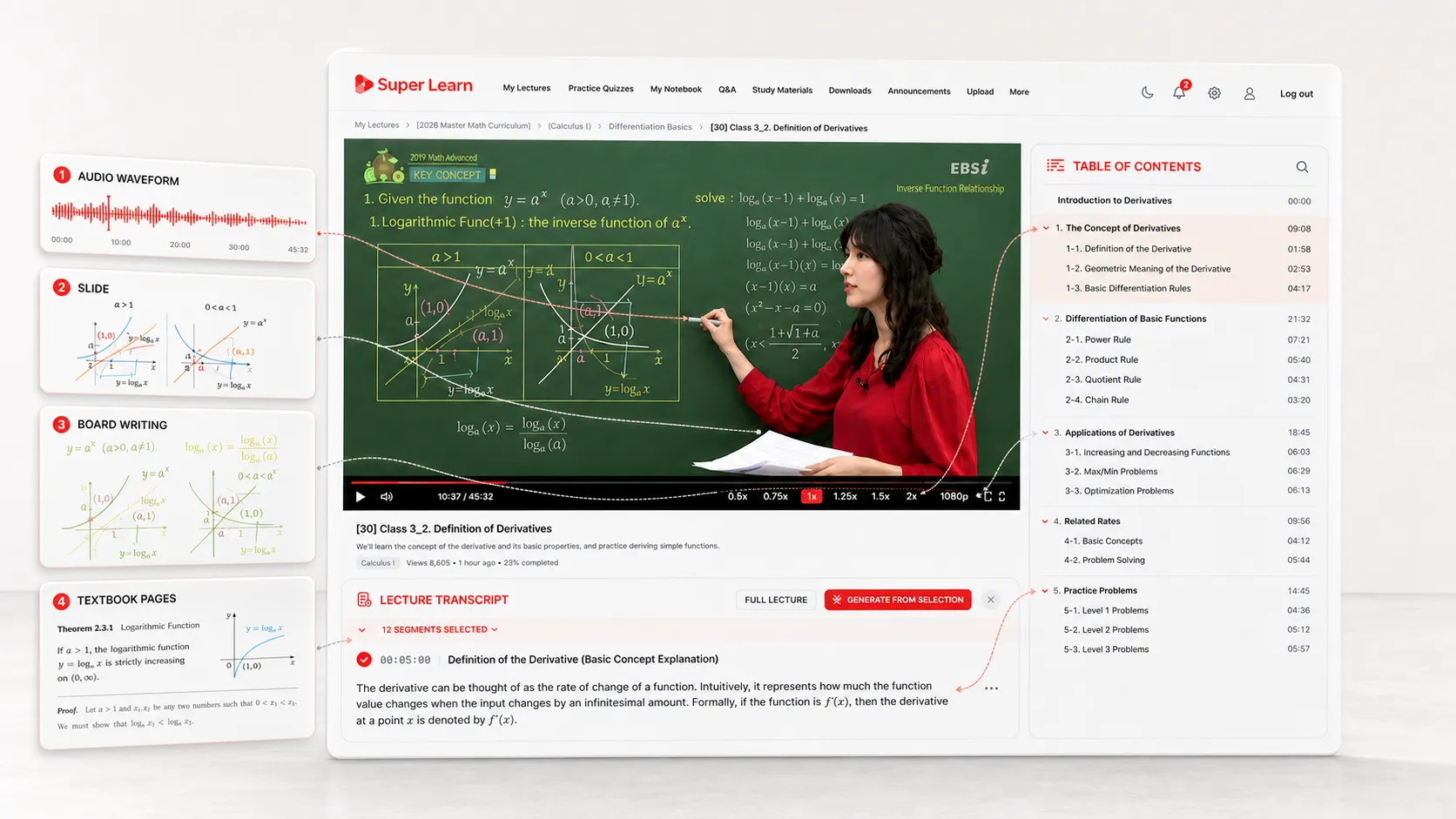
Speech, slides, board handwriting, and textbook pages are projected into one shared vector space. Handwriting is reconstructed as LaTeX — the derivation written on the board becomes text you can search.
03
Segment
A learned model fuses five concurrent signals — voice activity, scene cuts, slide changes, stroke changes, topic drift — to split each lecture at real topic boundaries. The result is a clickable table of contents, not fixed time blocks.
04
Answer
Questions are answered only from retrieved evidence. Every answer cites a video timestamp, a slide page, and a textbook page. When no evidence exists, the system says so.
Why SuperLearn
Three properties, built in — not bolted on.
Each one depends on the index itself, which is why they work together.
Handwriting is searchable
Board work is a stroke sequence, not a static image. SuperLearn reconstructs it into LaTeX and indexes it — so the moment a formula was written is retrievable, even when the audio only says 'move this over here'.
Segments follow meaning
Lectures split where topics actually change, not every five minutes. A 50-minute recording becomes labeled units — core concept, derivation, worked example — each one addressable and citable.
Refusal is a feature
The AI tutor answers from retrieved evidence or not at all. Refusing when evidence is absent is enforced by the architecture — protecting exactly the learners least equipped to detect a confident wrong answer.
Evidence-grounded answers
Every answer cites its sources.No sources, no answer.
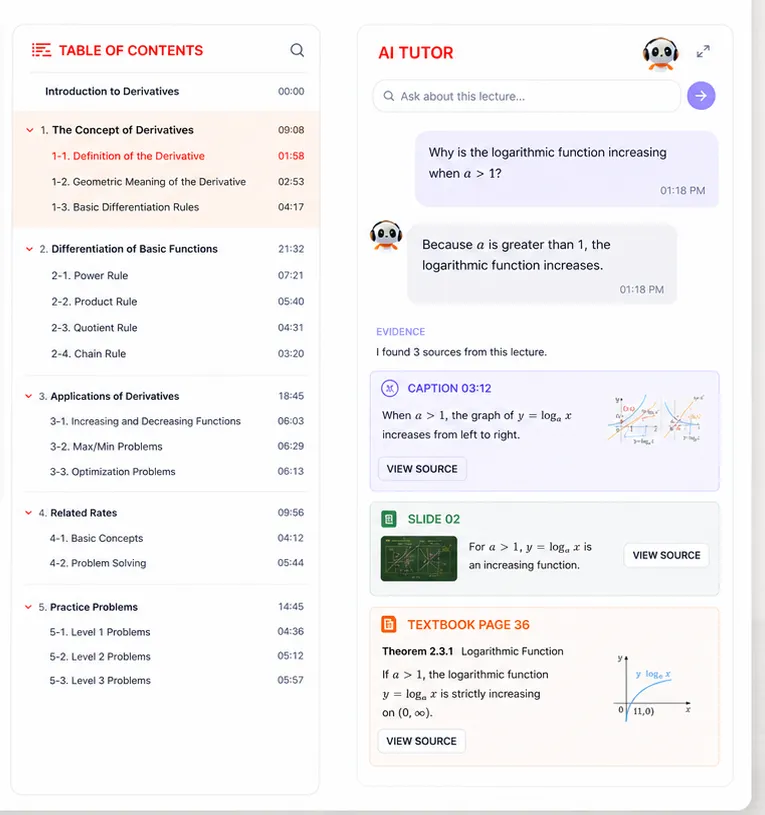
Ask the AI tutor a question and the answer arrives with three citations: the video timestamp where the instructor said it, the slide page that shows it, and the textbook page that defines it. One tap opens a split view with the original frame or page.
Verification stops being separate homework. For institutions, the same mechanism is an audit trail: anyone can trace any answer back to source material on the answer screen itself.
- Video timestamp
- Slide page
- Textbook page
And when there is no evidence — the system declines to answer and says why, instead of generating something plausible.
For instructors and content teams
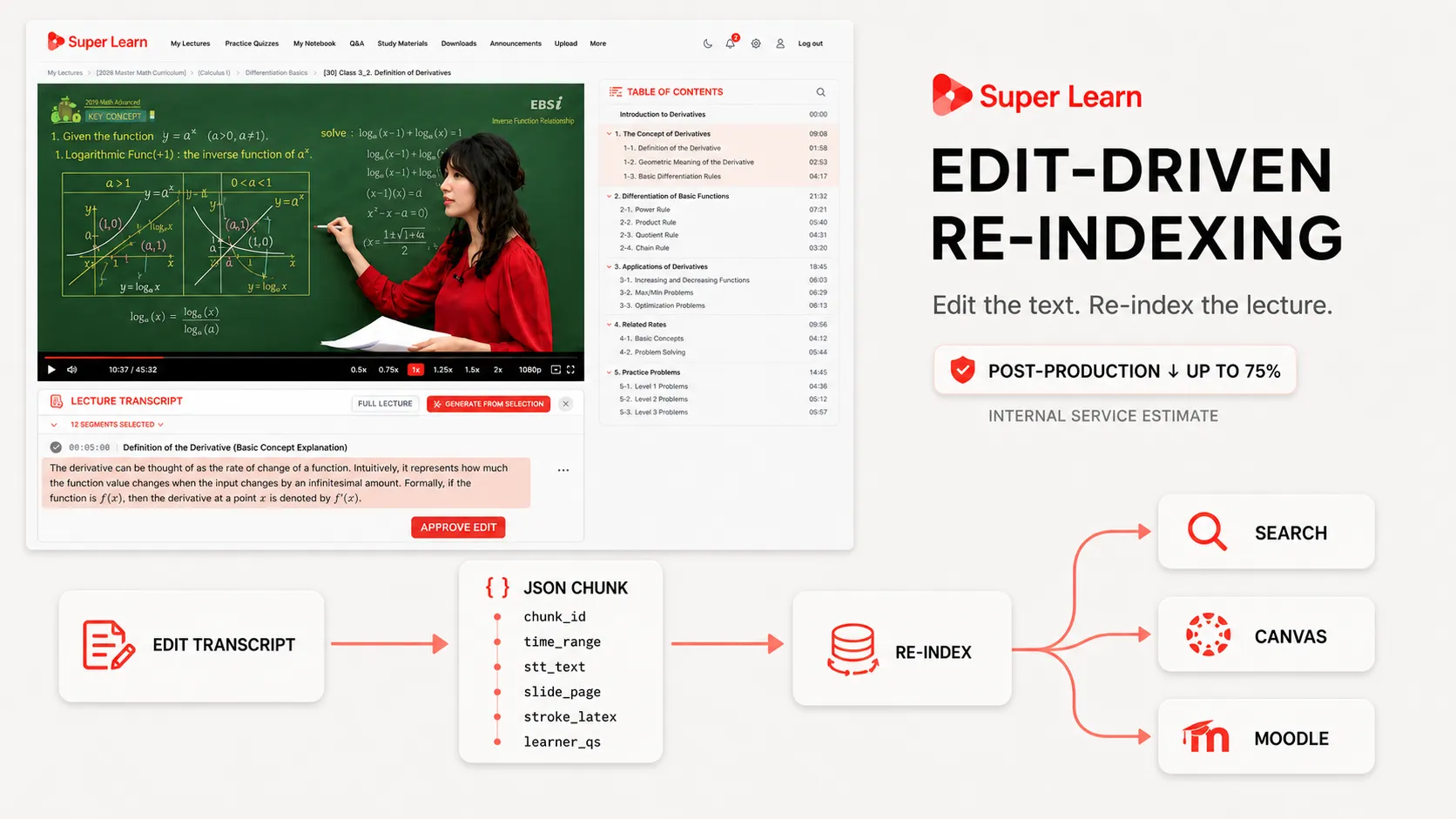
Edit the transcript. The video follows.
There is no timeline in the SuperLearn editor. Instructors delete sentences and reorder passages the way they would in a word processor, and the backend cuts the matching video and audio. AI pre-tags silence, filler words, and repetition as cut candidates; nothing changes until a human approves it.
Approved edits are saved as structured chunk data and re-indexed immediately — so every edit also sharpens search, and updated lectures flow straight back into Canvas and Moodle.
Up to 75%
less post-production time
Internal service estimate.
For institutions
Deploys inside the LMS you already run.
SuperLearn ships as cloud SaaS on web and mobile, with plug-ins for Canvas and Moodle and REST and GraphQL APIs. Adopting it is adding a plug-in, not migrating a platform.
Universities & colleges
Turn course archives into searchable study material. Learners land on the exact derivation, not minute 34 of a recording.
Vocational training & bootcamps
Per-hour indexing priced for public and vocational budgets, so the whole curriculum gets indexed — not just flagship courses.
Corporate L&D & compliance
Onboarding, job training, and compliance recordings become an auditable knowledge base. Every AI answer is traceable to a timestamp and page — and withheld when unsupported.
Deployment surface
- Cloud SaaS — web and mobile
- Canvas and Moodle plug-ins
- REST and GraphQL APIs
- Multi-tenant isolation at the identity, network, and database layers
- WCAG 2.1 AA interface with high-accuracy captions
- to index one lecture
5–15 min
to index one lecture
- per video hour, measured in service
Under $0.44
per video hour, measured in service
- course completion in service validation
82.6%
course completion in service validation
Measured with university-student cohorts of 213 and 400.
- filed in Korea, further filings in progress
2 patents
filed in Korea, further filings in progress
For learners
Study the moment, not the timeline.
If your lectures live on SuperLearn, this is what changes for you.
Click concepts, not timelines
Every lecture opens with a table of contents built from its actual topics. Search a keyword across all your lectures and jump to the exact moment it is taught.
Ask, then check the source
Ask the AI tutor anything about the lecture. Each answer links the caption, the slide, and the textbook page it came from — tap one to see the original.
Captions and notes included
High-accuracy captions and AI summary notes come with every lecture, and the interface meets WCAG 2.1 AA — the same content path for everyone.
Company
In commercial service since May 2026.
SuperLearn Inc. is a Korean AI company based in Daejeon. The platform is in service with education and training institutions in Korea and the United Kingdom, with pilot deployments in progress in the United States.
- In service
- Education and training institutions in Korea and the UK
- LMS supply agreement
- A UK education foundation, concluded May 2026
- Research
- Joint research program with a leading Korean university AI department
- Intellectual property
- Two Korean patents filed (10-2024-0170054, 10-2026-0073386); further filings on the core technologies in progress
See your own lectures indexed.
Bring one recorded lecture. We will return it searchable — table of contents, transcript, and evidence-grounded Q&A.